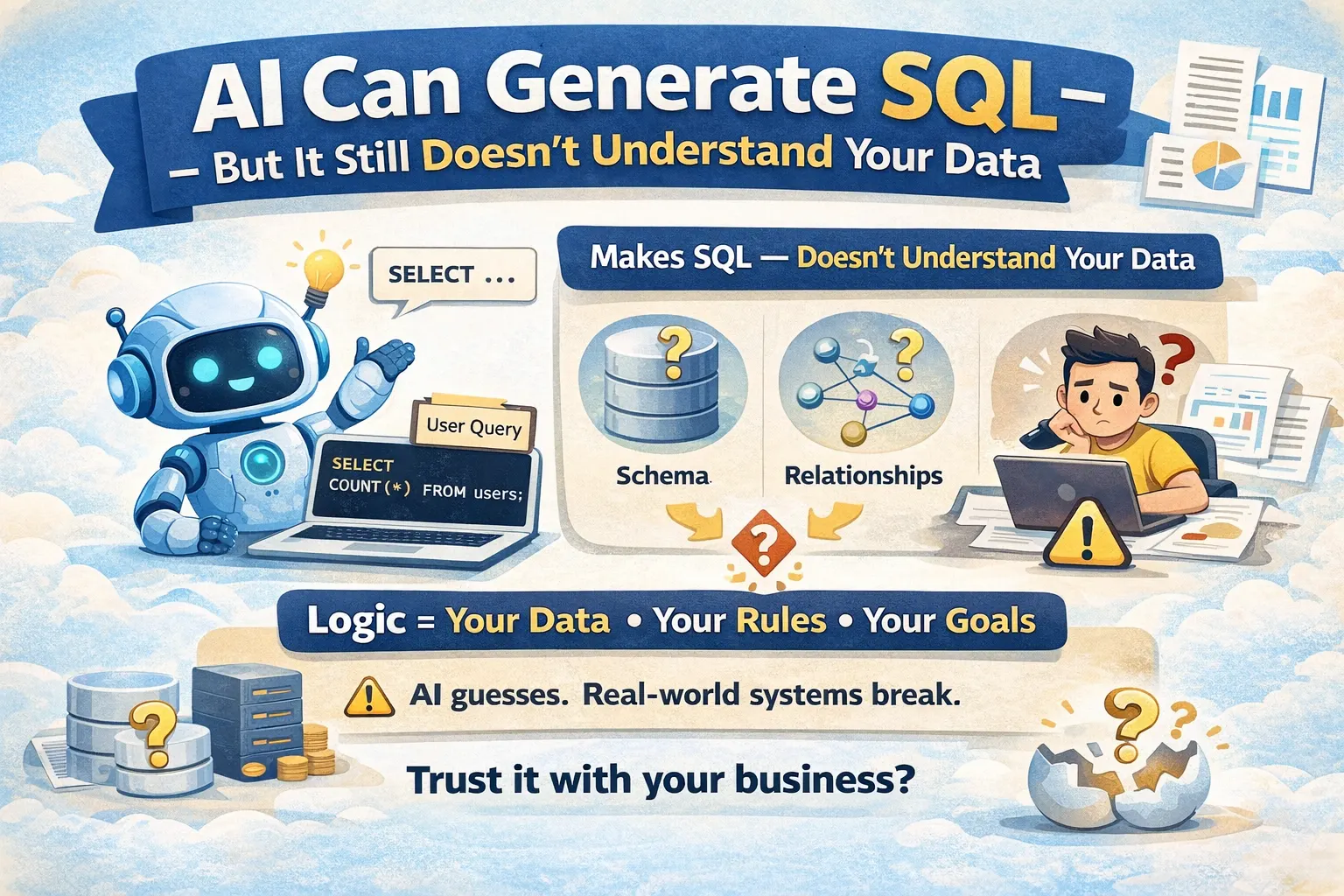
AI Can Generate SQL — But It Still Doesn’t Understand Your Data (or Your Business)
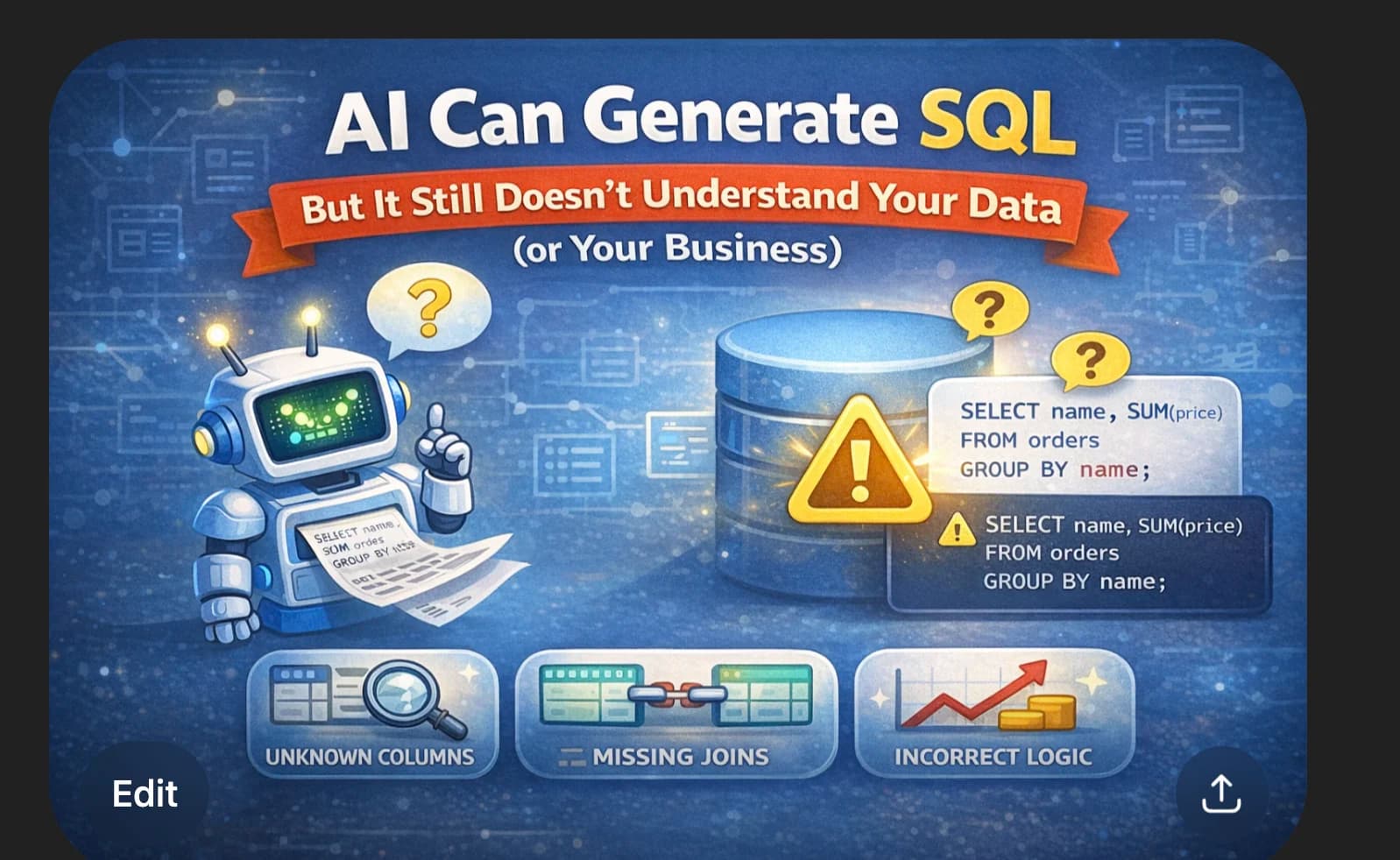
AI Can Generate SQL — But It Still Doesn’t Understand Your Data (or Your Business)
Everyone talks about text-to-SQL like it’s solved.
Just pass a prompt → get SQL → done.
But when you actually build it…
👉 Everything breaks.
The Illusion
At first, it feels simple:
“Give schema + user query → generate SQL”
And yes, for simple queries:
SELECT COUNT(*) FROM users;
It works.
Reality: Systems Are Not Simple
Real users ask:
“Show top customers last month by revenue excluding refunds”
Now the model must:
- understand joins
- filter refunds
- calculate revenue correctly
And this is where things fail.
🧠 How Real System Actually Works
Instead of raw prompting, I built a pipeline.
User Query
   ↓
Context Builder (Schema + Docs)
   ↓
LLM (SQL Generation)
   ↓
Validation Layer
   ↓
Execution
   ↓
Response + Feedback
1. Schema Injection (Foundation)
Before calling the LLM, I pass structured schema:
- tables
- columns
- relationships
Example:
Table: orders
Columns: id, user_id, price, status

Table: users
Columns: id, name
👉 This helps the model generate valid SQL
But:
👉 Large schema = confusion
👉 Small schema = missing context
2. RAG (Retrieval-Augmented Context)
Schema alone is not enough.
So I added context retrieval (RAG):
- business definitions
- query examples
- known patterns
Example:
"Revenue = SUM(price) where status = 'paid'"
👉 This guides the model
But still:
👉 AI does not truly understand this 👉 It just uses it probabilistically
⚠️ The Hidden Problem: More Context ≠ Better Results
At first, it feels logical:
“If we give more context, the AI will perform better.”
So we try:
- full database schema
- detailed documentation
- multiple examples
But something unexpected happens.
👉 The model starts hallucinating more.
Why This Happens
LLMs don’t understand context like humans.
They:
- process tokens probabilistically
- try to match patterns
- get confused with too much input
When context grows:
- important signals get diluted
- irrelevant tables affect output
- model mixes unrelated concepts
Real Example
You provide:
- 20 tables
- 200+ columns
User asks:
“Show top customers”
AI might:
- pick wrong table
- join unrelated tables
- use incorrect columns
👉 Not because it's bad 👉 But because too much context reduces clarity
3. The AI Agent (Generation Layer)
The LLM acts like an agent.
Input:
- user query
- schema
- retrieved context
Output:
- SQL query
But problems still happen:
- hallucinated joins
- wrong aggregations
- incorrect filters
4. Validation Layer (MOST IMPORTANT)
Before executing SQL, I validate:
- table existence
- column existence
- allowed operations
- query limits
👉 Without this → system breaks
5. Feedback Loop (Continuous Improvement)
After execution:
- log bad queries
- track failures
- refine prompts
- improve retrieved context
👉 System improves over time
❗ The Real Problem: Business Understanding
Even after all this:
AI still fails.
Because it doesn’t understand business meaning.
Example:
“Revenue”
In real systems:
- exclude refunds
- exclude failed payments
- include or exclude taxes
👉 AI doesn’t know this unless defined
And even then:
👉 It may still apply it incorrectly
⚠️ Why AI Still Fails
Even with:
- schema injection
- RAG
- validation
AI still:
- guesses intent
- lacks reasoning
- produces logically wrong SQL
🧠 Key Insight
AI is not replacing backend logic.
👉 It requires backend engineering around it
🚧 Where I Am Right Now
I’m still improving this system every day.
- refining prompts
- improving schema selection
- improving RAG quality
- handling edge cases
👉 It’s not perfect
But it’s getting better.
🏁 Final Thought
Don’t ask:
“Can AI generate SQL?”
Ask:
“Can I trust this in production?”
That’s the real challenge.