Queues & Background Jobs: The Missing Layer in Most Backend Systems
Queues & Background Jobs: The Missing Layer in Most Backend Systems
Most backend systems are built like this:
User → API → Database → Response
It works.
Until it doesn't.
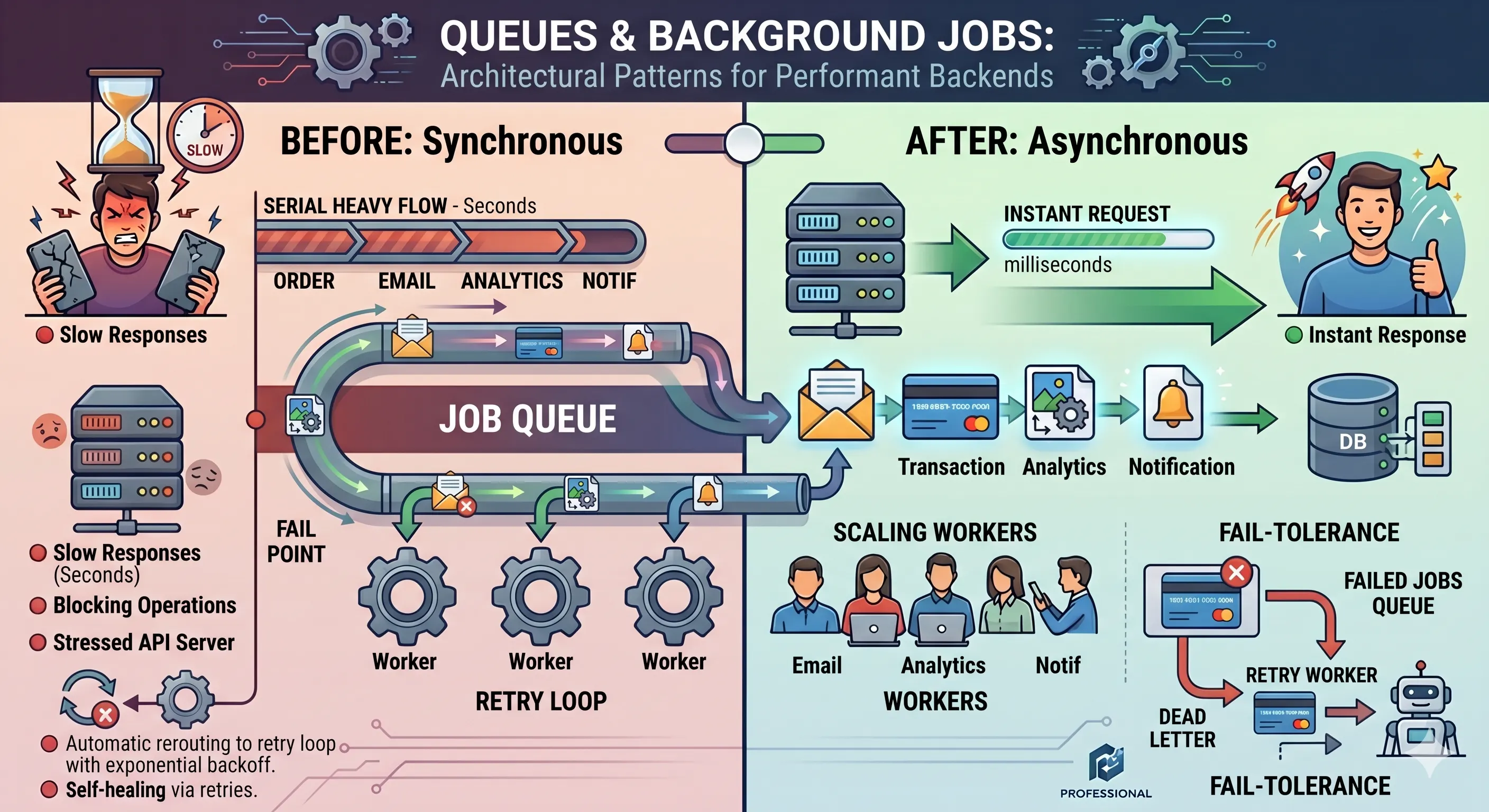
The Problem with Synchronous Systems
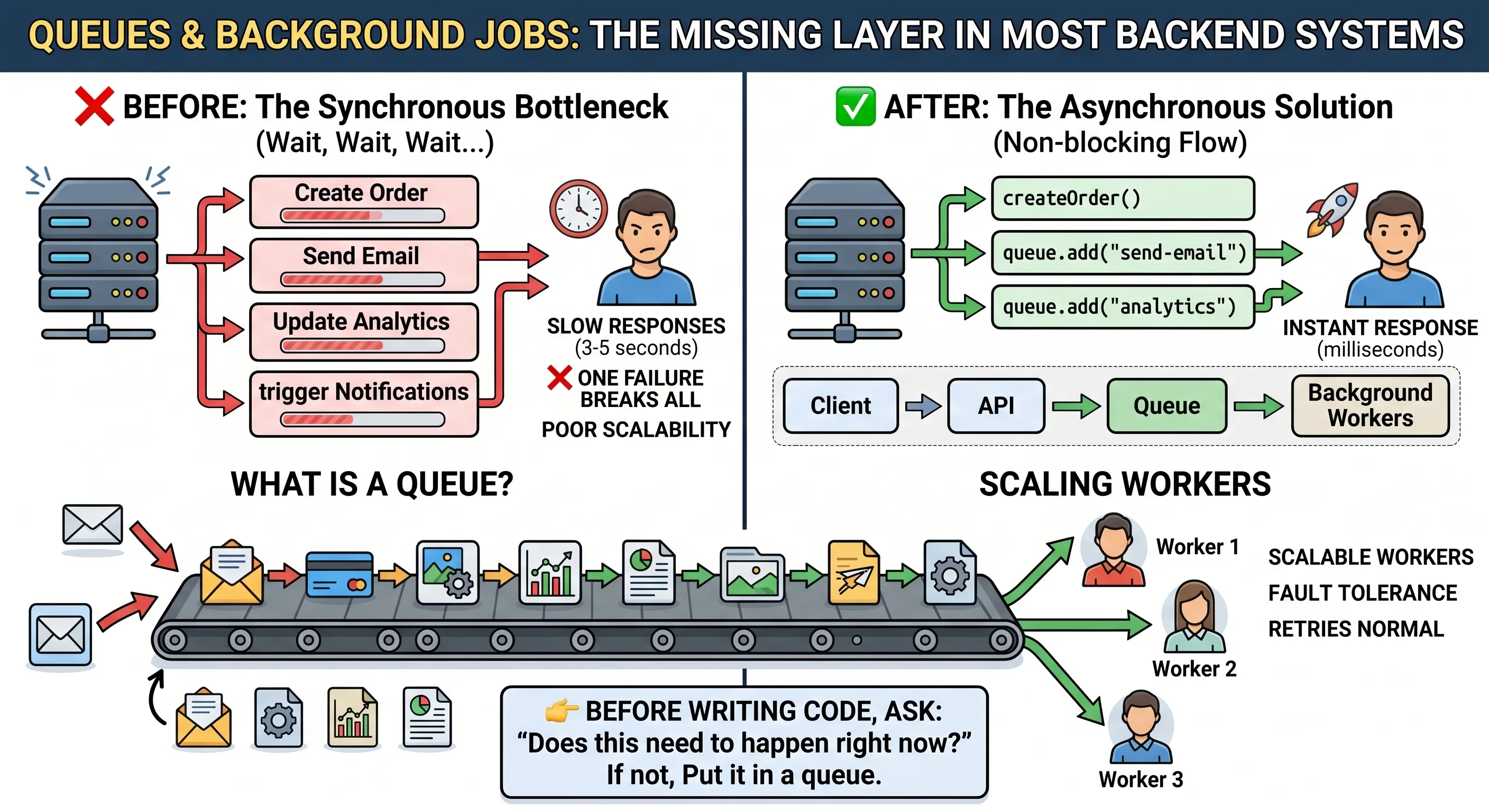
You handle everything in a single request:
- Create order
- Send email
- Update analytics
- Trigger notifications
await createOrder();
await sendEmail();
await updateAnalytics();

return response;
What Goes Wrong?
❌ Slow responses (3–5 seconds) ❌ One failure breaks everything ❌ Poor scalability
The Core Insight
Not everything needs to happen right now.
Some things should happen later.
The Queue-Based Architecture
          ┌──────────────┐
          │    Client     │
          └──────┬───────┘
                 ↓
          ┌──────────────┐
          │     API       │
          └──────┬───────┘
                 ↓
          ┌──────────────┐
          │    Queue      │
          └──────┬───────┘
                 ↓
        ┌───────────────────┐
        │ Background Workers │
        └───────────────────┘
Refactoring the Flow
❌ Before (Blocking)
await createOrder();
await sendEmail();
await updateAnalytics();
✅ After (Non-blocking)
await createOrder();

await queue.add("send-email", { userId });
await queue.add("analytics", { orderId });

return response;
👉 User gets instant response 👉 Work continues in background
What is a Queue?
A queue stores tasks to be processed asynchronously.
Common Jobs
- Email notifications
- Payment processing
- Image resizing
- Analytics tracking
- Report generation
Background Worker Example
import { Worker } from "bullmq";

const worker = new Worker("jobs", async (job) => {
  if (job.name === "send-email") {
    await sendEmail(job.data.userId);
  }
});
Retry Mechanism (Critical)
Failures are normal.
Queues handle them automatically.
await queue.add("send-email", data, {
  attempts: 3,
  backoff: {
    type: "exponential",
    delay: 1000
  }
});
👉 Temporary failures won't break your system
Delayed Jobs (Powerful Feature)
await queue.add("reminder-email", data, {
  delay: 1000 * 60 * 60
});
👉 Execute after 1 hour
Real-World Example: Order System
Without Queue
User → API → Payment → Email → Analytics → Response (slow)
With Queue
User → API → Order Created → Response (fast)
                    ↓
                Queue
                    ↓
        Payment / Email / Analytics
Scaling Workers
You can run multiple workers:
Worker 1
Worker 2
Worker 3
👉 Jobs processed in parallel 👉 System scales horizontally
Key Benefits
1. Performance
- Faster APIs
- Non-blocking operations
2. Reliability
- Retry failed jobs
- Fault tolerance
3. Scalability
- Add more workers
- Handle high load
When NOT to Use Queues
- Simple CRUD apps
- Low traffic systems
- Immediate results required
Key Insight
Most backend systems are slow because they try to do everything synchronously.
Final Takeaway
If your system handles:
- emails
- payments
- heavy processing
👉 You NEED queues.
Closing Thought
Before writing code, ask:
👉 "Does this need to happen right now?"
If not:
👉 Put it in a queue.